How RFID expands the possibilities of Industrial Vending
Efficiency and accuracy are critical for businesses in a fast-paced world. Radio Frequency Identification technology, or RFID, is a proven way for enhancing traceability in supply chains and inventory processes. This is the main reason why it has become an important technology in modern industrial vending.
RFID removes many physical limitations of traditional vending machines. Instead of fixed dispensing, it enables flexible shelving, real-time inventory visibility and faster refilling. As a result, RFID is changing what is possible in advanced industrial vending.
How RFID works in industrial vending
RFID technology uses electromagnetic fields to automatically identify RFID tags. In simple terms, the RFID reader sends out a signal and asks, “Who’s here?”. The tags then respond with their unique ID information.
This allows hundreds of tagged items to be identified in just a couple of seconds, without direct line of sight. Compared with visual barcode scanning, RFID makes item identification significantly faster and more flexible.
RFID tags are attached to the items that need to be tracked. In industrial vending, these typically include personal protective equipment PPE, tools and industrial consumables, such as packages of screws, gloves, tapes and batteries.
Tagging is typically a manual work phase that can be done as part of the warehouse or shelving process. Although it requires an extra step, it enables several important benefits in industrial vending:
- Flexible shelving: products can be placed in the unit freely, without size limitations of fixed lockers, coils or bins.
- Fast refilling: tagged products are identified automatically when placed inside the vending unit. No separate confirmation or admin configuration is needed.
- Seamless self-service experience: smooth access to different types of vending units, like vending cabinets, containers and self-checkout systems.
- Improved inventory accuracy: stock levels can be tracked automatically in real-time.
- Better asset traceability: tools, shared equipment and other valuable items can be tracked more accurately.
Traditional vending machines vs. RFID based vending
Traditional vending machines are designed to provide controlled access: the user can only take the item they have selected. Units such as coil machines and carousels also set limitations on product size, and refilling often needs to be done item by item. Typically, these machines are used for dispensing consumables, although some carousels and especially lockers can also be used for dispensing assets, such as tools. However, one question remains: does the returned item match the one that was originally taken?
Modern industrial vending solutions with RFID technology do not have these limitations. A unit with RFID inventory allows products to be placed freely on open shelves. Assets, such as tools, and consumables can even be stored side by side. The refill process is also straightforward: tagged items are simply placed inside the vending unit, and that’s it.
With RFID, users can access multiple items simultaneously, while the system still knows what has been taken, when it happened and by whom.
User identification and product tracking
When we talk about industrial vending solutions, RFID can be used for two things: identifying users and identifying products. Both processes happen automatically.
Access to the vending unit can be limited to authorized users only. Users can be identified with an RFID card or badge.
When the user opens the doors, they get immediate access to all items stored in the vending unit. Users have the freedom to browse the selection, take a closer look at product details or even try on gloves to find the right size. When the choices have been made, the user closes the doors. At this moment, the purchase is done and the information is reported to the backend system.
The system also updates real-time inventory data, showing which items are still inside the unit, which items were taken out, when this happened and even which project they were used for.
RFID expands industrial vending
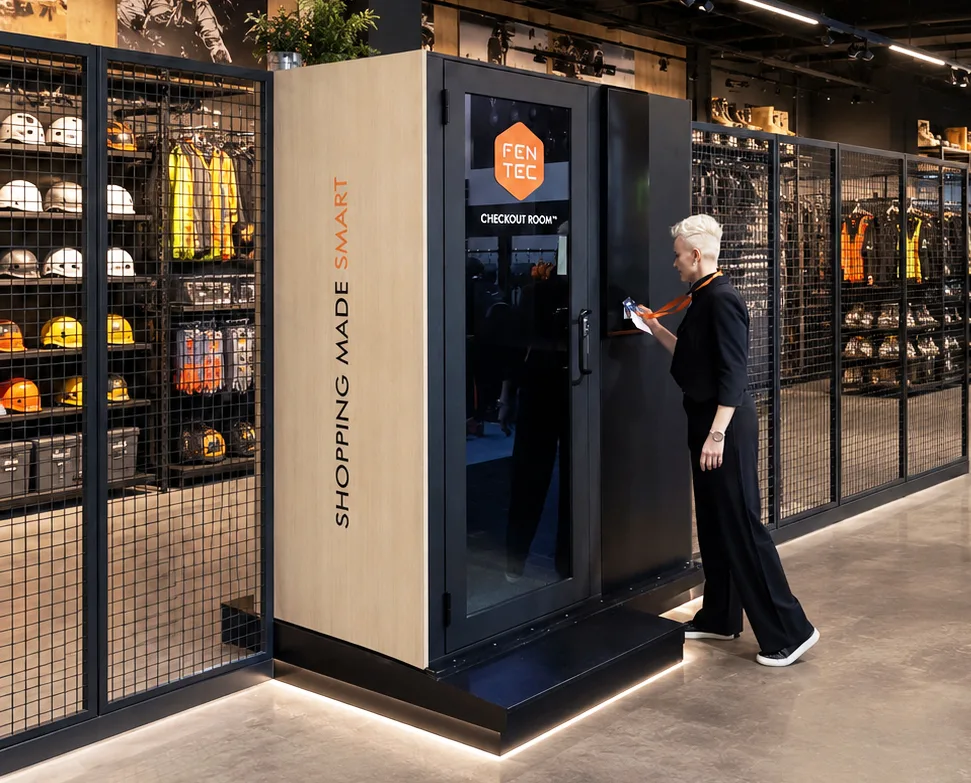
Besides industrial vending cabinets, RFID also creates new possibilities for automated self-checkout solutions. Instead of multiple vending machines, they can be used as a gateway solution to a centralized store that can offer unlimited product selection. The number of shelves and the store size can be freely chosen.
The magic happens at the self-checkout: when the user exits the store with selected products, the items are identified automatically. There is no need to scan products one by one. After the user has confirmed the purchase, the information is reported to the backend system.
This kind of automated and reliable self-service solution represents the next step of industrial vending.
Things to consider when adopting RFID
The basics of RFID technology are easy to understand. In practice, successful implementation requires planning from both a business and technical perspective.
- Start with a clear business goal. RFID should support what you want to improve, whether it is streamlining sales, automating internal processes or strengthening customer commitment through a better user experience. The best results come when RFID is part of a connected inventory and service model.
- Evaluate products and environment. Metal, liquids and surrounding surfaces can affect how RFID works. A partner that understands the technology can help evaluate the right setup for your products and use case.
- Use a purpose-built solution. Controlling the RFID signal is essential. A regular metal cabinet is rarely enough, as the signal can leak through gaps and openings. Reliable RFID inventory requires a unit designed for this purpose.
- Create a clear tagging process. Each sales item needs an RFID tag so it can be identified automatically. With the right workflow, tagging can be integrated into warehouse, shelving or supplier processes in a practical way.
- Look at both efficiency and sales potential. RFID can reduce manual work, improve real-time inventory visibility, support faster replenishment and strengthen customer commitment. The benefits are highest when the solution is integrated with existing systems, such as ERP.
Conclusion
RFID technology is expanding what industrial vending can do by improving efficiency, flexibility, and inventory accuracy. With free placement of products, open shelving and automatic real-time tracking, it removes many of the limitations of traditional vending machines.
This makes user experience easier, refilling faster and item tracking more accurate for PPE, consumables, tools and shared assets. As a result, businesses gain better control, better data and a more flexible way to manage critical supplies.
The real value of RFID is not only in tracking products. It is in making industrial vending more connected, scalable and efficient.
**
Check out how FENTEC uses RFID in industrial vending >
Read how Würth uses RFID-based vending technology in practice >